

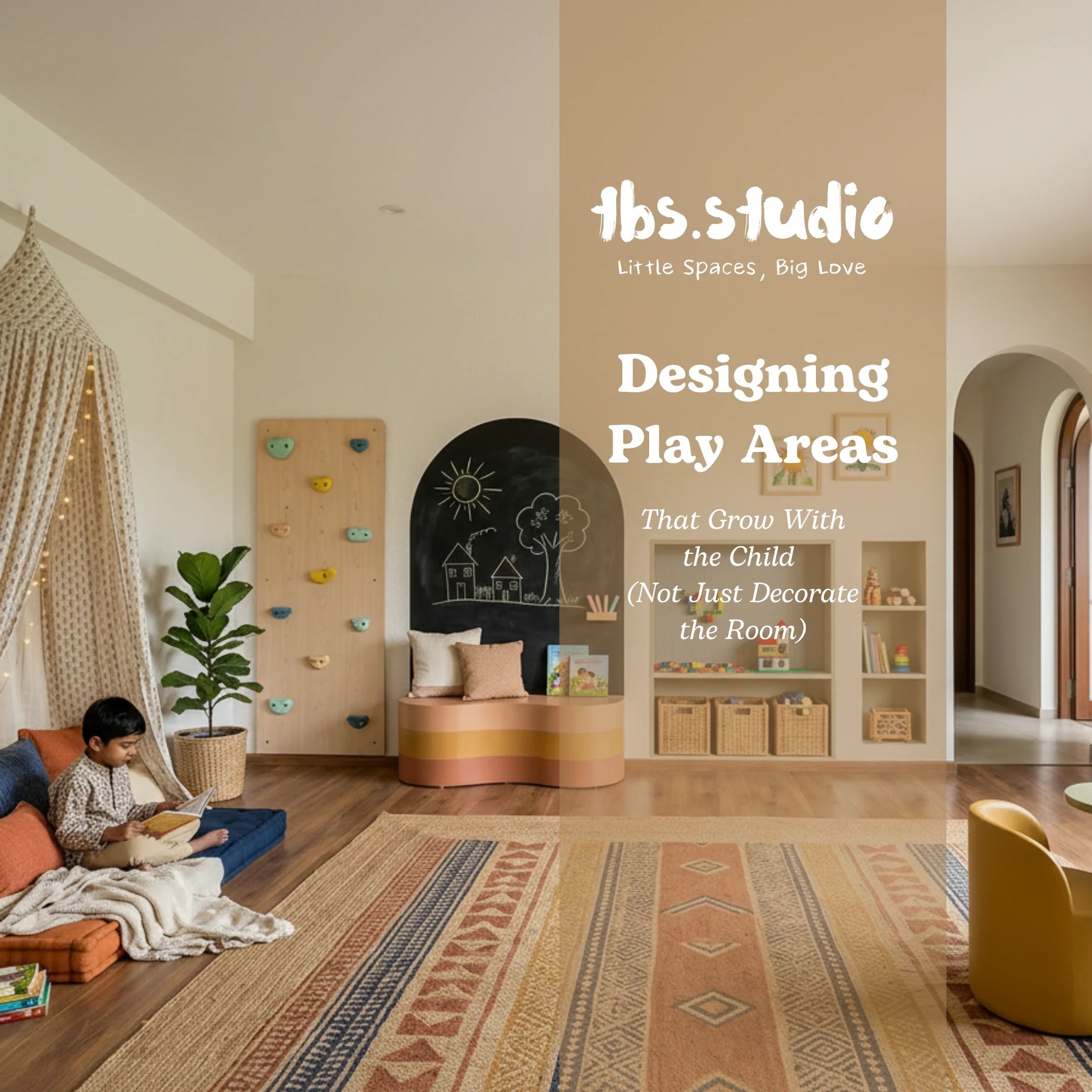
Introduction: Beyond Pretty Playrooms
A visually pleasing playroom may photograph beautifully, but real childhood is far less staged. Toys move, interests shift, and a toddler’s fascination with stacking quickly becomes a six-year-old’s obsession with drawing, building, and independent exploration. Designing play areas purely as decorative corners often overlooks one critical truth: children evolve faster than furniture trends.

At TBS Studio, we believe the goal is not to create a “perfect” playroom for today, but a thoughtful space that adapts seamlessly over the years. When a play area is designed for longevity, it reduces replacement cycles, minimizes clutter stress, and most importantly, supports developmental growth without constant redesign.
The Problem with “Theme-Based” Play Areas
Theme-led playrooms — whether jungle, princess, or superhero — may feel exciting initially, but they often age faster than the child using them. What delights at age three can feel restrictive by age six, and visually overwhelming environments can unintentionally reduce focus and imaginative flexibility.

Overstimulating colours, character-heavy graphics, and rigid themed furniture often prioritize décor over usability. When every visual element demands attention, children have fewer opportunities for open-ended play. The result is a space that looks curated but functions poorly for daily, evolving routines.
Luxury design, in contrast, is not about excess visual drama; it is about restraint, adaptability, and timelessness.
How Children Actually Use Play Areas (Real Behaviour Insights)
Observing how children truly interact with their spaces reveals patterns very different from how adults plan them.

Younger children gravitate toward floor-based play, spreading puzzles, blocks, and books across open surfaces. As they grow, micro-activities emerge — quick sketching, reading, craft bursts, and building projects that demand flexible surfaces rather than fixed stations.
Movement is constant. Children shift between activities rapidly, often creating “zones” organically rather than respecting the boundaries adults set. This is why open-ended layouts consistently outperform rigid, compartmentalized setups. A well-designed play area allows motion, mess, and imagination to coexist without chaos.
Core Principle: Design for Growth, Not Age

0–3 Years: Sensory-Safe & Low-Height Access
At this stage, safety and sensory exploration dominate. Low open shelves, soft finishes, and easily reachable storage empower early independence while maintaining visual calm. Furniture should invite touch, exploration, and safe mobility.
3–6 Years: Imagination + Storage Independence
As imaginative play deepens, children begin to organize their belongings and develop preferences. Accessible bins, modular storage, and flexible surfaces support storytelling, art, and creative chaos while teaching responsibility in a subtle way.
6–10 Years: Activity Zoning (Study + Play Blend)
Older children require hybrid spaces where study and play intersect naturally. A reading nook, a craft surface, and an adaptable desk become more relevant than toy-centric layouts. The design language should mature alongside the child without feeling like a forced transition.
Planning Zones Instead of Filling Corners
A common mistake in kids’ room design is filling every corner with furniture, leaving little room for actual play. Instead, zoning creates clarity and purpose within the same footprint.

Quiet Play Zone: Ideal for puzzles, board games, and solo activities that require concentration.
Creative / Mess-Friendly Zone: A dedicated area for art, building, and experimentation where materials are easy to access and clean.
Reading & Wind-Down Nook: Soft seating, warm lighting, and minimal visual distraction encourage calm engagement with books.
Flexible Central Floor Space: The most underestimated yet most used zone — open floor area that adapts to whatever activity the child chooses that day.
Zoning acknowledges behaviour patterns rather than imposing adult assumptions about how children should play.
Furniture That Evolves With the Child
Luxury children’s interiors are defined not by ornate pieces but by intelligent modularity. Furniture should transition as effortlessly as childhood itself.

Modular shelving systems can shift from toy storage to book displays and eventually to hobby organization. Convertible desks and adjustable seating accommodate changing heights and needs without replacing entire setups. Thoughtfully designed storage evolves from holding plush toys to housing school supplies and creative tools.
This adaptability not only enhances usability but also ensures long-term aesthetic consistency within the room.
Safety That Doesn’t Look “Childish”
Safety is non-negotiable, but it does not need to translate into visually juvenile design. Rounded edges, matte finishes, and durable laminates provide protection while maintaining a refined, luxury aesthetic.

Instead of loud colours often associated with children’s furniture, calm palettes and tactile materials create a sense of quiet sophistication. Invisible safety — anti-tip mechanisms, soft-close hardware, and ergonomic proportions — ensures the room remains secure without visually announcing it.
True luxury lies in safety that integrates seamlessly into the design language.
The Role of Materials & Finishes in Longevity
Material selection significantly influences how well a play area ages. Neutral woods, soft linens, and high-quality laminates outlast bright plastics both functionally and visually. While bold colours may feel engaging initially, they often lead to aesthetic fatigue and require faster redesign cycles.

Durable, easy-to-maintain finishes are essential for real daily wear. Spills, scratches, and constant movement are part of childhood, and materials should accommodate this reality gracefully rather than resist it.
Designing for longevity means anticipating real-life usage, not just visual appeal on installation day.
Common Design Mistakes to Avoid

Even well-intentioned playrooms can fall short when functionality is overlooked.
Oversized toy storage can dominate the room, leaving little space for actual play. Ignoring circulation flow restricts movement and disrupts natural activity patterns. Most importantly, designing solely for the child’s current age often leads to rapid obsolescence, forcing repeated redesigns within just a few years.
A thoughtful approach considers where the child is today — and where they will be tomorrow.
Conclusion: A Play Area That Grows, Adapts, and Stays Relevant
Designing a play area is not about creating a snapshot of childhood; it is about crafting an evolving environment that supports every stage of growth. When spaces are planned with flexibility, calm aesthetics, and intelligent zoning, they remain relevant long after specific toys and interests change.

At TBS Studio, our philosophy centres on longevity over novelty — designing rooms that adapt gracefully, emotionally, and functionally as children grow. Because the most meaningful children’s spaces are not those that look perfect for a year, but those that continue to feel right for many years to come.
Because childhood changes fast. The room should be ready for every stage.


